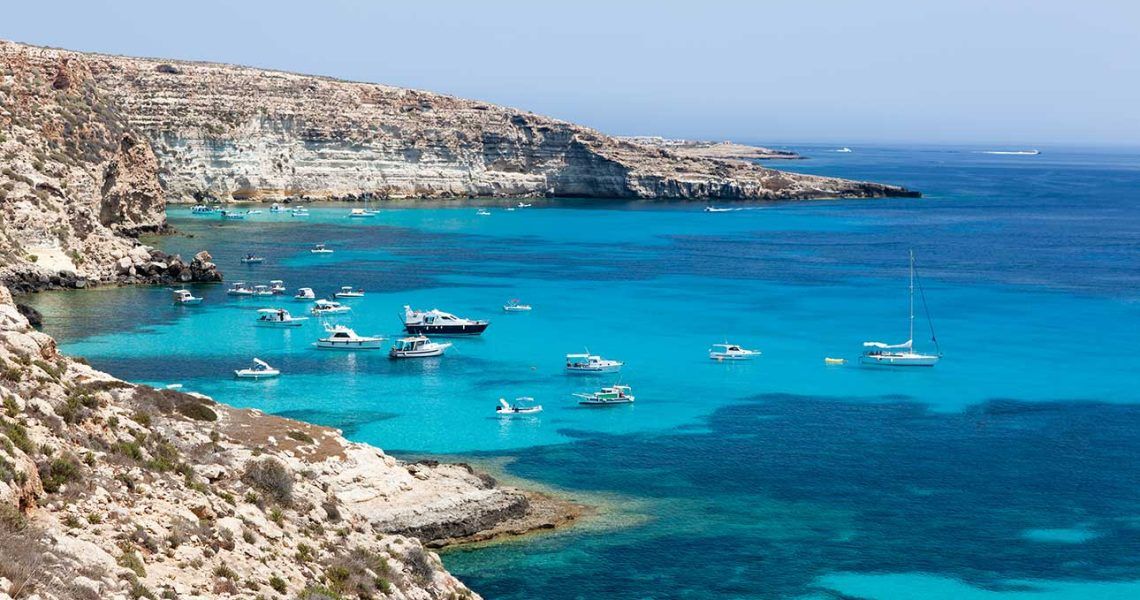
One of the most recurrent maneuvers when we go sailing, is the anchoring maneuver, since it is estimated that, while in use, a pleasure boat spends about 80% of the time at anchor.
And the fact is that most of the activities we do on a pleasure boat are carried out when it is stopped: sunbathing on the boat's solarium, swimming in the crystal clear waters of that wonderful cove, having a snack...
In this post we want to review the points to keep in mind when anchoring. If you have recently obtained your sailing license and you are planning to rent your first boat, we recommend you to read it carefully to review basic concepts.
Anchoring is understood as mooring our boat, inflatable boat or yacht on the seabed.
Anchoring can be done with an anchor (or several) or with a dead anchor usually marked with a buoy. These utensils are attached to the boat by means of the so-called anchor line, which consists of a rope or a chain or both. Normally the anchor is attached to the anchor line by means of a shackle.
The most common, especially if we rent a boat, is to anchor with only one anchor.
As with everything in life, a series of rules and recommendations must also be followed when anchoring to ensure that the maneuver is carried out safely. It is advisable to analyze all the factors that influence anchoring and take them into account before deciding where and how to anchor the boat. The main factors to take into account are:
- Nature of seabed. Type of anchorage.
- Type of anchor and/or mooring line. Length and weight of the anchor and/or anchor line.
- Weather conditions. Wind direction.
- Presence or not of other boats, rocks or coastline near the anchorage point.
Choosing the anchorage, first step
It is advisable to find out ifthere are any anchoring restrictions or specific zones in the area where we are going to sail.
Anchoring in posidonia meadows should be avoided. It is forbidden in many places as these meadows must be preserved. They are great filter feeders, oxygen producers and breeding and refuge areas for many marine species.
If you are going to rent a boat with us and leave from the port of Caleta de Velez, most probably you will decide to visit the area of the cliffs of Maro-Cerro Gordo. In that case it is important that you take into account that there are restricted areas for anchoring.
There is no visual signage of the area, but in the following map you can visualize the restricted anchoring area (the outermost box) and the free anchoring areas delimited in front of Torre del Pino cove, Cala del Cañuelo cove and Cantarriján beach.
Once the anchoring area has been chosen, we must pay attention to the seabed. As we have already said, we should not anchor if we see posidonia meadows, but this is not the only thing we must take into account.
In rocky areas it will be very easy to grab the anchor, with the risk of even losing it! and in sandy areas it will anchor very well, although we will have to leave more anchor line than in rocky areas and this will extend the bore radius.
Paying attention to the weather, second step
The second step is to check if there is wind and in which direction it is blowing . We must always place the boat with the bow to the wind, so that it is already in the final anchoring position.
If there is a lot of wind, the anchor and anchor line may not be sufficient to secure the position and we should look for a more sheltered area or even return to port.
Depth, third step
To measure the depth the most practical way is tohave a depth sounder on the boat as you will find in any of our Quicksilver available in Puerto de la Caleta. If it is a shallow area we can do it "by eye".
The depth will tell us two things to take into account:
- The amount of mooring line to release
- The borneo radius, or the distance we must leave with other ships.
In normal weather conditions, without wind or waves, it is recommended to leave about three lengths of anchor line. The more the wind blows, the more line should be dropped.
As can be expected, the boat may move in circles around the anchor if the wind veers. Therefore, it is important to leave a sufficient safety distance from other boats, at least the distance of the anchor line plus a couple of extra lengths.
It is recommended to make a slight reversing maneuver once the anchor is dropped so that the anchor grips the bottom. Once the anchoring maneuver is finished, we wait for a prudent time to make sure that the boat stops drifting.
When the boat is stable , we will take two lines (one to port and one to starboard), as far apart and as opposite as possible. This sounds very technical, but it is nothing more than looking at two fixed points of reference such as a rock, a house, the profile of the coast ... If after about 15 minutes we check that the lines we have taken remain stable, it means that we are not anchoring and we will consider the anchoring finished. It will be time to have a snack, take a swim and, in short, enjoy.